🌳 Ep. 235: The Ottoman Empire – Top 6 Facts Memory Mnemonic
👋 Intro
Hello and welcome to this episode of the podcast, "The Mnemonic Memory", where we add a single mnemonic leaf to our Tree of Knowledge.
I’m Jans, your Mnemonic Man, and today's episode will be on an empire that spanned parts of Europe, Asia, and Africa: the Ottoman Empire.
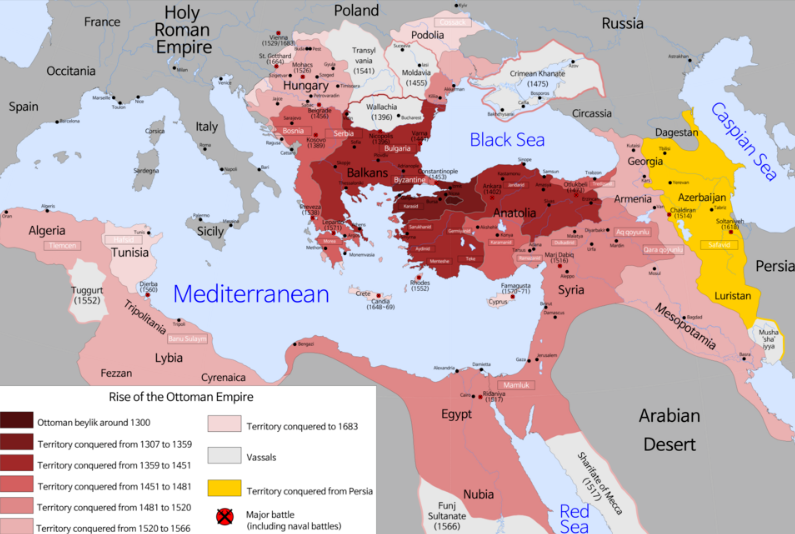
The Ottoman Empire began as a small principality called Beylik in northwestern Anatolia. It was founded by Osman I around 1299 and expanded rapidly. In 1453, the empire reached a turning point when Sultan Mehmed II captured Constantinople, ending the Byzantine Empire and making it the Ottoman capital.
The empire reached its height during the 16th and 17th centuries under Sultan Suleiman the Magnificent. They controlled key trade routes linking Europe and Asia and possessed military strength, which included their elite Janissary corps.
The empire’s administration was managed through the millet system, which allowed religious autonomy, community courts, tax collection, and loyalty exchange, which was protection and religious freedom in exchange for paying a special tax called jizya.
The empire was renowned for its architectural achievements, including magnificent mosques, palaces, bridges, and public buildings. Along with this, Ottoman culture flourished through advances in literature, calligraphy, music, ceramics, and cuisine.
The empire entered a gradual decline economically and militarily in the late 17th century. Faced with increasing internal challenges, nationalist movements, and military defeats, the Ottoman Empire was dissolved in 1922 following its defeat in World War I.
In 1923, the Republic of Turkey was established under Mustafa Kemal Atatürk, marking the end of the Ottoman era.
Today’s mnemonic will be on the top six facts about the Ottoman Empire.
So, with that being said, we will begin with a summary from Wikipedia.
📖 Wikipedia Summary
The Ottoman Empire, also called the Turkish Empire and sometimes Turkey (Türkiye) was a country in the Middle East between 1299 and 1923.
Its most important city was Constantinople, in Anatolia. At its best years, it controlled a very big part of the Middle East, including Balkans, North Africa, and the Arabian Peninsula.
The empire was founded by Osman I in 1299. It was highly successful between 1400 and 1600 and it controlled trade and politics in Southeastern Europe, Southwest Asia, and Northern Africa.
In the Ottoman Empire, there was a system called "millet". This meant that different religious groups were allowed to follow the rules of their own religion, and they could have their own leader.
These leaders talked to the Sultan for them. This system helped people live more peacefully together, especially in big cities like Constantinople. The empire was a group of conquered countries. The Sultan sent governors to manage these countries, or cities. These governors were called Pasha or Bey.
The most famous one in the early 19th century was Muhammad Ali Pasha. The empire also had tributary states, which were states that gave money to the Ottoman Empire. In the 1800s, other countries in Europe, like England, were becoming rich by following the Industrial Revolution: their machines could make a product faster and cheaper than a human could.
On the other hand, the merchants of the Ottoman Empire did not have these machines, so they could not compete with the Europeans. Also, because of the nationalism movement, some people in the Empire wanted to have their own country.
Since it had lots of war ships and guns from Germany, the Empire decided to support Germany in World War I, and it attacked Russia. It was defeated in the war, and the Ottoman Empire ended. After that, a modern republic was created by Mustafa Kemal Atatürk, and it was called the Republic of Turkey.
Extracted from: [https://simple.wikipedia.org/wiki/Ottoman_Empire]

🧠 Memory Mnemonic
The Ottoman Empire – Top 6 Facts Memory Mnemonic – MEGaFaCT
(Picture the mega fact about the Ottoman Empire of fratricide, which was institutionalised under Sultan Murad III and Mehmed II, whereby a newly crowned sultan would legally have all his infant and adult brothers executed to prevent civil war.)
1. Millet system was an Ottoman administration framework
2. Empire was dissolved in 1922, leading to modern Turkey
3. Golden Age was in the 16th century under Suleiman the Magnificent
4. Founded in 1299 by Osman I
5. Captured Constantinople in 1453 under Mehmed II
6. Topkapi Palace was the sultan’s residence
🔎 Five Fun Facts
1. The Ottoman Empire lasted for 623 years, having been founded around 1299 and survived until 1922. During that time, it was ruled by 36 sultans from the same dynasty. At its height in the late 1600s, the Ottoman Empire stretched from Hungary in Europe to Yemen in the Middle East and Algeria in North Africa. This equates to 5 million square kilometres of territory, the equivalent of roughly half the size of the United States.
2. The founder of the Ottoman Empire was Osman I, who was a Seljuk Turk. His name is sometimes spelt Ottman or Othman, hence the term ‘Ottoman’. The Seljuks arrived from the Asiatic steppes in the 11th century AD, where Osman transitioned from a local chief to an independent ruler. He founded the small principality of Beylik, which grew into the Ottoman Empire.
3. In 1453, Sultan Mehmed II, also known as Mehmed the Conqueror, captured the city of Constantinople after a 53-day siege. This victory ended the Byzantine Empire, which had lasted for over 1,000 years. Constantinople then became the Ottoman capital, which eventually evolved into modern-day Istanbul.
4. The empire's political headquarters and the sultan's residence was Topkapi Palace. For nearly 400 years, the palace housed thousands of people, including the royal family, officials, servants, artisans, and soldiers. It was built by Sultan Mehmed II in 1459 and features four main courtyards, a private Harem, and grand treasury rooms. In 1924, it was turned into a public museum and is also a UNESCO World Heritage Site.
5. The Ottoman Empire ruled over a diverse population of different religions, languages, and ethnic groups. It managed much of this diversity through the millet system, which allowed many non-Muslim religious communities to administer their own schools, courts, and places of worship, while remaining under Ottoman rule.


🎓 Three-Question Quiz
Q.1. In what year was the Ottoman Empire traditionally founded?
Q.2. Which Ottoman sultan conquered Constantinople?
Q.3. What was the name of the Ottoman Empire's elite infantry force? Options are the Janissaries or the Unsullied
Bonus Q. What famous beverage did the Ottomans help popularise throughout the Middle East and Europe?
Bonus Q. Across how many continents did the Ottoman Empire stretch at its greatest extent?
Bonus Q. What was the Ottoman Empire's main export?
🧠 Memory Mnemonic Recap
The Ottoman Empire – Top 6 Facts Memory Mnemonic – MEGaFaCT
(Picture the mega fact about the Ottoman Empire of fratricide, which was institutionalised under Sultan Murad III and Mehmed II, whereby a newly crowned sultan would legally have all his infant and adult brothers executed to prevent civil war.)
1. Millet system was an Ottoman administration framework
2. Empire was dissolved in 1922, leading to modern Turkey
3. Golden Age was in the 16th century under Suleiman the Magnificent
4. Founded in 1299 by Osman I
5. Captured Constantinople in 1453 under Mehmed II
6. Topkapi Palace was the sultan’s residence
🎓 Three-Question Quiz Answers
Q.1. In what year was the Ottoman Empire traditionally founded?
A. 1299
Q.2. Which Ottoman sultan conquered Constantinople?
A. Mehmed II, also known as Mehmed the Conqueror
Q.3. What was the name of the Ottoman Empire's elite infantry force? Options are the Janissaries or the Unsullied
A. The Janissaries. The Unsullied were eunuch slaves, who were castrated males
Bonus Q. What famous beverage did the Ottomans help popularise throughout the Middle East and Europe?
A. Coffee
Bonus Q. Across how many continents did the Ottoman Empire stretch at its greatest extent?
A. Three continents, which included Europe, Asia, and Africa
Bonus Q. What was the Ottoman Empire's main export?
A. Sultan Pepper!
🔤 Word of the Week
Conspectus
[kuhn-spek-tuhs]
conspectuses
1. a general or comprehensive view; survey.
2. a digest; summary; résumé.
Example
A concise conspectus of the Ottoman Empire reveals its remarkable rise, vast territorial expansion, and lasting cultural influence.
Extracted from: [https://www.dictionary.com/]
💡 Memory Tip
For our memory tip today, we will be talking about the benefits of meat to a healthy brain.
Eating meat provides many key nutrients to support a healthy brain. Some of these nutrients include:
• Vitamin B12 for healthy nerve tissue and energy metabolism in the nervous system
• Iron for carrying oxygen to your brain cells
• Zinc for brain cell communication and also supports memory
• Creatine, which gives a boost of energy to muscle and brain cells
Eating meat should be part of a balanced diet, and the more unprocessed, the more nutrient-dense and thus better for a healthy brain and healthy body. See you next week.
👉 Free Memory Mnemonics at:
🎧 Listen on Apple Podcasts:
https://podcasts.apple.com/au/podcast/the-mnemonic-memory-podcast/id1591795132
🎧 Listen on Spotify:
https://open.spotify.com/show/3T0LdIJ9PBQMXM3cdKd42Q
🔗 References
https://www.factinate.com/things/42-audacious-facts-about-the-ottoman-empire
https://upjoke.com/ottoman-jokes
https://kids.kiddle.co/Ottoman_Empire
https://themuslimvibe.com/western-muslim-culture/10-things-you-didnt-know-about-the-ottoman-empire