
🌳 Ep. 234: Galápagos Islands – Five Islands that are Inhabited Memory Mnemonic
👋 Intro
Hello and welcome to this episode of the podcast, "The Mnemonic Memory", where we add a single mnemonic leaf to our Tree of Knowledge.
I’m Jans, your Mnemonic Man, and today's episode will be on a paradise of nature, the Galápagos Islands.
Located in a volcanic archipelago in the Pacific Ocean about 1,000 kilometres west of mainland Ecuador, the Galápagos Islands are known for their extraordinary biodiversity and unique wildlife.
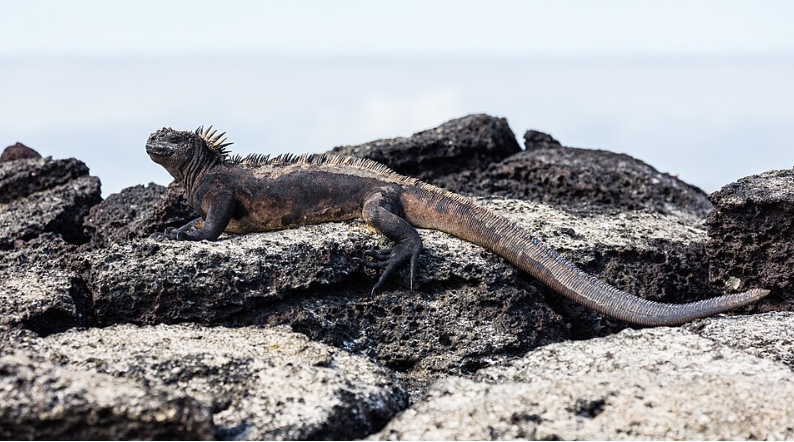
The Galápagos Islands consist of 13 major islands, 6 smaller islands, and over 100 rocky islets. Due to the islands’ isolation, a number of unique species have evolved, some of which include the giant Galápagos tortoise, marine iguanas, blue-footed boobies, the Galápagos penguin, and a variety of finches.
The islands’ wildlife played a pivotal role in science, with the naturalist Charles Darwin developing his theory of evolution by natural selection, published in On the Origin of Species in 1859. Today, 97% of the Galápagos Islands is protected as the Galápagos National Park, while the remaining 3% of the land is reserved for human settlements and civil infrastructure.
The Galápagos Islands were declared a UNESCO World Heritage Site in 1978 and remain one of the most untouched and pristine environments on Earth. Tourism is carefully managed on the islands along with strict limitations on visitor numbers and the activities that can be undertaken.
Today’s mnemonic will be on the five islands that are inhabited in the Galápagos Islands.
So, with that being said, we will begin with a summary from Wikipedia.
📖 Wikipedia Summary
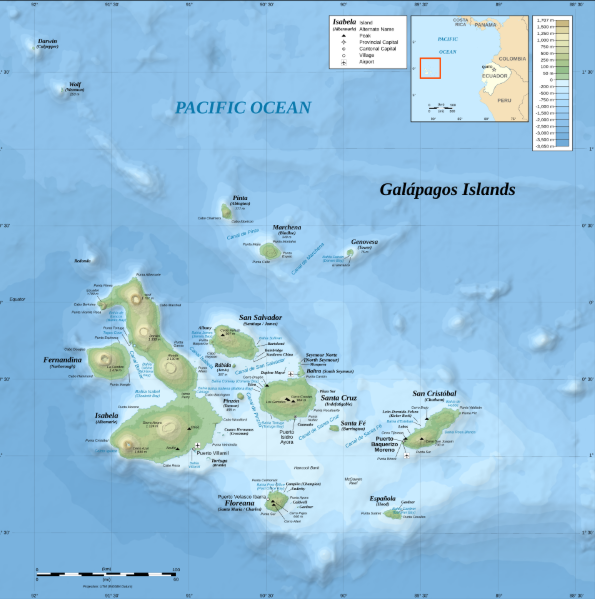
The Galápagos Islands (Spanish: Islas Galápagos) are an archipelago of volcanic islands in the Eastern Pacific, located around the equator, 485 nautical miles (898 km; 558 mi) west of the mainland of South America. They form the Galápagos Province of the Republic of Ecuador, with a population of slightly over 33,000 in 2020. The province is divided into the cantons of San Cristóbal, Santa Cruz, and Isabela, the three most populated islands in the chain.
The Galápagos are famous for their large number of endemic species, which were studied by Charles Darwin in the 1830s and inspired his theory of evolution by means of natural selection. All of these islands are protected as part of Ecuador's Galápagos National Park and Marine Reserve.
There is no firm evidence that Polynesians or the Indigenous peoples of South America reached the islands before their accidental discovery by Bishop Tomás de Berlanga in 1535. If some visitors did arrive, poor access to fresh water on the islands seems to have limited settlement.
The Spanish Empire similarly ignored the islands, although during the Golden Age of Piracy, various pirates used the Galápagos as a base to raid Spanish shipping along the Peruvian coast. The goats and black and brown rats introduced during this period greatly damaged the existing ecosystems of several islands. British sailors were chiefly responsible for exploring and mapping the area.
Darwin's voyage on HMS Beagle was part of an extensive British survey of the coasts of South America. Ecuador, which won its independence from Spain in 1822 and left Gran Colombia in 1830, formally occupied and claimed the islands on 12 February 1832 while the voyage was ongoing.[2] José de Villamil, the founder of the Ecuadorian Navy, led the push to colonize and settle the islands,[2] gradually supplanting the English names of the major islands with Spanish ones.
The United States built the islands' first airport as a base to protect the western approaches of the Panama Canal in the 1930s. After World War II, its facilities were transferred to Ecuador. With the growing importance of ecotourism to the local economy, the airport modernized in the 2010s, using recycled materials for any expansion and shifting entirely to renewable energy sources to handle its roughly 300,000 visitors each year.
Extracted from: [https://en.wikipedia.org/wiki/Gal%C3%A1pagos_Islands]
🧠 Memory Mnemonic
Galápagos Islands – Five Islands that are Inhabited Memory Mnemonic – FIBSS
(Picture the five inhabited islands of the Galápagos out of the 13 major (principal) islands, where the residents lie, or fib, about how good it is to live there so they can keep this paradise to themselves.)
1. Floreana
2. Isabela
3. Baltra
4. San Cristóbal
5. Santa Cruz
🔎 Five Fun Facts
1. It took millions of years to form the Galápagos Islands through volcanic eruptions. These eruptions continue to this day over a stationary column of hot magma rising deep from inside the Earth called a “hotspot,” which continues to form and reshape parts of the archipelago.
2. Charles Darwin visited the Galápagos Islands in 1835 aboard the HMS Beagle on his epic five-year voyage. This trip formed the foundation for his theory of evolution by natural selection. He primarily noticed that similar animals differed slightly from island to island, particularly the famous finches, whose beaks differed in shape and size depending on the specific food available.
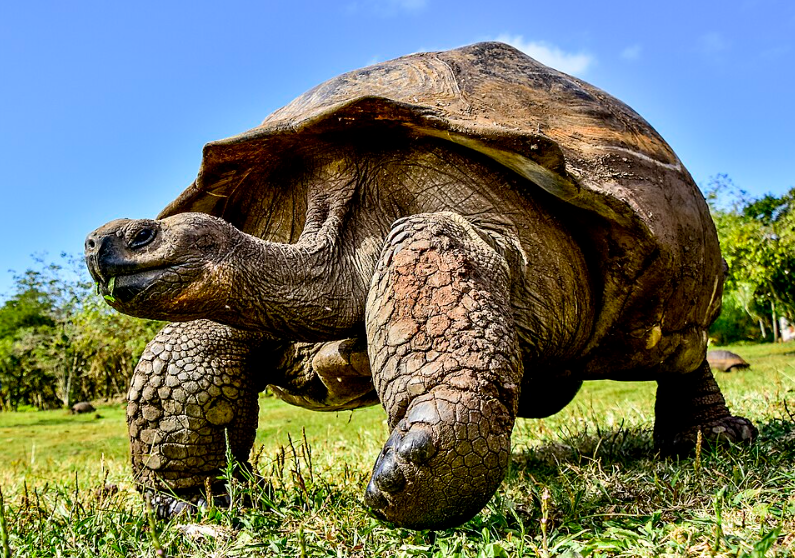
3. The star of the islands, the Galápagos giant tortoise, is the largest living species of tortoise in the world. As well as being the largest, they also have a lifespan of over 100 years in the wild. They have an extremely slow metabolism and can survive without food or water for up to a year. The most famous captive tortoise, called Harriet, lived for an estimated 175 years old and spent her last years at the Australia Zoo under the care of Steve and Terri Irwin.
4. Though the Galápagos Islands are on and around the equator, they contain a species that is more at home in the Antarctic. The Galápagos penguin is the only species of penguin that lives and breeds north of the equator. They survive the tropical heat by nesting in cool volcanic caves and swimming in the cold, nutrient-dense currents. They are one of the smallest penguin species and cannot be found anywhere else on Earth.
5. One of the most astonishing facts about the Galápagos Islands animals is that they are not scared of humans. They exhibit a unique biological trait known as “island tameness”. This is because they lack predators and have evolved in isolation, and thus never developed a “fight or flight” instinct. As a result, the Galápagos National Park enforces strict rules for visitors to maintain a 6-foot or 2-metre distance from the animals at all times.


,_Las_Bachas,_isla_Santa_Cruz,_islas_Gal%C3%A1pagos,_Ecuador,_2015-07-23,_DD_23.jpg)
🎓 Three-Question Quiz
Q.1. In which ocean is the Galápagos Islands located?
Q.2. Which country do the Galápagos Islands belong to?
Q.3. What famous naturalist visited the Galápagos Islands in 1835 aboard HMS Beagle?
Bonus Q. Approximately how many major (principal) islands make up the Galápagos archipelago?
Bonus Q. Why are Ecuadorians so healthy?
🧠 Memory Mnemonic Recap
Galápagos Islands – Five Islands that are Inhabited Memory Mnemonic – FIBSS
(Picture the five inhabited islands of the Galápagos out of the 13 major (principal) islands, where the residents lie, or fib, about how good it is to live there so they can keep this paradise to themselves.)
1. Floreana
2. Isabela
3. Baltra
4. San Cristóbal
5. Santa Cruz
🎓 Three-Question Quiz Answers
Q.1. In which ocean is the Galápagos Islands located?
A. The Pacific Ocean. About 600 miles off the coast of Ecuador
Q.2. Which country do the Galápagos Islands belong to?
A. Ecuador
Q.3. What famous naturalist visited the Galápagos Islands in 1835 aboard HMS Beagle?
A. Charles Darwin
Bonus Q. Approximately how many major (principal) islands make up the Galápagos archipelago?
A. 13 major (principal) islands
Bonus Q. Why are Ecuadorians so healthy?
A. Apparently, according to scientists, the Quito Diet!
🔤 Word of the Week
au fond
[oh fawn]
French.
1. at bottom or to the bottom; basically; in reality; fundamentally.
Example
Au fond, the Galápagos Islands remind us that protecting nature is essential to preserving Earth's incredible biodiversity.
Extracted from: [https://www.dictionary.com/]
💡 Memory Tip
For our memory tip today, we will be talking about leafy green vegetables, which include foods such as spinach, broccoli, lettuce, arugula, silverbeet, and cabbage.
These leafy green vegetables are among the best foods for supporting brain health and maintaining cognitive function. Many leafy greens are rich in vitamins K, C, and E, folate, lutein, beta-carotene, and other antioxidants.
Folate supports healthy nerve function and the production of neurotransmitters involved in memory and mood. Vitamin K plays a role in brain cell signalling. Lutein accumulates in the brain and is associated with better memory and processing speed, while beta-carotene protects the brain from free radicals and thus reduces inflammation.
So, several servings per day of your leafy greens can help support long-term brain health. See you next week.
👉 Free Memory Mnemonics at:
🎧 Listen on Apple Podcasts:
https://podcasts.apple.com/au/podcast/the-mnemonic-memory-podcast/id1591795132
🎧 Listen on Spotify:
https://open.spotify.com/show/3T0LdIJ9PBQMXM3cdKd42Q
🔗 References
https://chatgpt.com/c/6a5a376c-a99c-83ec-ae0f-7e169186f579
https://upjoke.com/ecuador-jokes
https://whc.unesco.org/en/list/1/